

Solana Price Prediction: Can SOL Recover to $150 as PYTH Gains Attention and Remittix Prepares for Its Next Move?
The cryptocurrency market is giving investors several different stories to follow in October 2026. Solana (SOL) is attracting attention as traders assess its recovery potential, Pyth Network (PYTH) is drawing interest around its market-data business and token economics, and Remittix (RTX) is positioning itself around crypto payments and financial technology.
These projects operate in different parts of the digital asset market. Solana provides blockchain infrastructure for decentralized applications, Pyth supplies price data to blockchain applications and financial platforms, and Remittix promotes a payment-focused ecosystem designed to connect cryptocurrency with traditional banking.
Recent market coverage placed SOL near $110 and reported a sharp one-day gain for PYTH in early October. Those figures represent dated market snapshots rather than guaranteed current prices. For investors considering the next move, the more important questions are whether these projects can sustain demand, demonstrate real adoption and navigate the risks facing the broader crypto market.
Solana Price Prediction: What Could Drive SOL Toward $150?
Solana remains one of the established blockchain networks competing for activity across decentralized finance, trading, payments and other on-chain applications. Its investment case depends on more than short-term price movements. Developers need to keep building, users need to remain active, and the network must continue to compete with alternative blockchain ecosystems.
In an October 12 report, TechBullion discussed Solana’s recent slot-time upgrade, reporting that the network’s slot time had fallen from 400 milliseconds to 200 milliseconds following the final stage of the rollout on October 9. Faster slots can improve network responsiveness, although they do not guarantee higher SOL prices or eliminate every performance challenge.
SOL Price Targets and Potential Upside
Using $110 as an illustrative reference price from the recent market coverage, investors can evaluate several possible price levels.
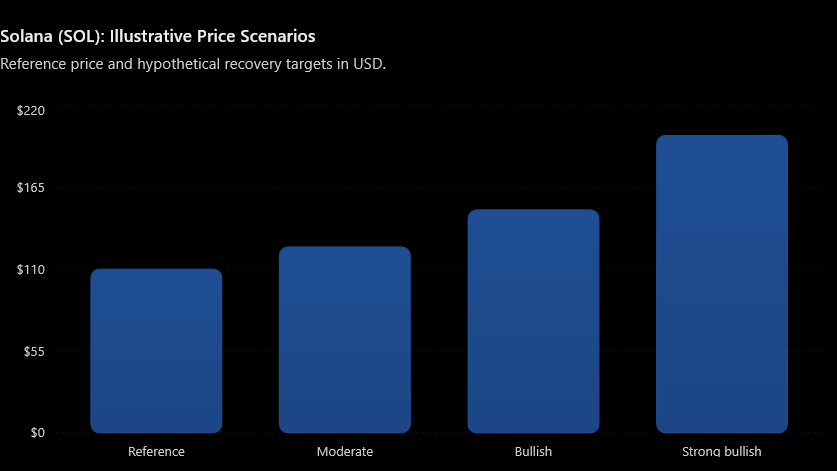
These are scenario calculations, not analyst-confirmed targets or predictions that SOL will reach these prices.
A move toward $125 could represent a moderate recovery from the reference level. Reaching $150 would require stronger buying pressure and a supportive market environment. A move to $200 would be a more aggressive scenario, requiring substantially greater demand and sustained momentum.
| SOL price scenario | Illustrative price | Change from $110 |
|---|---|---|
| Reference price | $110 | 0% |
| Moderate recovery | $125 | +13.6% |
| Bullish target | $150 | +36.4% |
| Strong bullish scenario | $200 | +81.8% |
What Could Support Solana’s Next Rally?
Several factors could influence SOL’s direction:
-
Network activity: Continued use of decentralized exchanges, payment applications and other blockchain services could support demand for Solana’s infrastructure.
- Technical development: Improvements to transaction processing and network responsiveness may strengthen the developer experience.
- Market liquidity: Bitcoin’s direction, institutional participation and broader risk appetite can influence altcoin performance.
- Competition: Solana must continue attracting developers and users while competing with Ethereum and other blockchain networks.
The bearish case deserves equal attention. A broader market sell-off, declining on-chain activity, network problems or reduced speculative demand could weaken SOL even if its technology continues to improve.
Pyth Network (PYTH): Why Its Oracle Business Matters
Pyth Network occupies a different position in the cryptocurrency ecosystem. Rather than operating primarily as a general-purpose blockchain, it provides financial market data that decentralized applications can use to reference asset prices.
Price feeds are important to decentralized exchanges, lending protocols, derivatives platforms and other applications that need reliable market information. Incorrect or outdated data can create significant risks for applications that rely on it.
According to Solana Compass’s October 2026 project overview, Pyth has expanded its data coverage across cryptocurrencies, equities, foreign exchange, commodities and indices. Its infrastructure connects data publishers with applications that need financial information.
PYTH’s Token Economics and Market Outlook
Recent reporting has highlighted a Pyth DAO initiative intended to direct funds received from Pyth products toward accumulating PYTH for a reserve. The announcement could make the relationship between the network’s commercial activity and its token more important to investors.
However, a token accumulation mechanism should not be confused with guaranteed price appreciation. Its potential effect depends on the amount of revenue generated, the timing and execution of purchases, token supply dynamics and overall market demand.
| Factor | Why it matters for PYTH |
|---|---|
| Data product adoption | More paying customers could strengthen the business case |
| Revenue growth | Commercial performance may provide insight into demand for its services |
| Token reserve mechanism | Could connect product receipts with token accumulation |
| Token supply | Unlocks and circulating supply can affect market pressure |
| DeFi activity | Demand for reliable price feeds may change with application usage |
The central question is whether Pyth can convert demand for financial data into durable business growth while maintaining a meaningful relationship between that growth and PYTH’s token.
Investors should also distinguish between a short-term rally and a longer-term trend. A strong daily performance can attract attention, but follow-through in trading volume, token demand and product adoption matters more when evaluating sustainability.
Remittix (RTX): A Payment-Focused Crypto Project to Watch
Remittix presents a different investment narrative. Its stated focus is PayFi, a term used for financial products that combine blockchain-based assets with payment services.
The project promotes a model in which supported cryptocurrencies can be converted into fiat currency and transferred through compatible banking routes. If implemented successfully, this type of service could appeal to people who need to move money between digital assets and conventional financial accounts.
Nevertheless, a project’s intended use case is not the same as proven adoption. Investors should verify the availability of payment routes, supported currencies, transaction costs, geographic restrictions and actual customer activity before drawing conclusions about its commercial potential.
Remittix Developments Investors Should Verify
Recent TechBullion coverage has reported several Remittix-related milestones, including a live Markets platform, cumulative trading volume exceeding $50 million, more than 10,000 reported iOS wallet downloads and testing of selected EUR and USD payment routes with invited users.
These are project-related claims reported in market coverage, not independently audited performance figures established by this article. Readers should check the project’s official announcements and available product documentation before relying on them.
The project has also been associated with a planned November 24, 2026, token debut. A planned date is not proof that an exchange listing will occur as scheduled. Investors should verify the latest official announcement, the token contract, the exchange details and the applicable sale terms.
You May Read Also: XRP ETF Inflows and Crypto Presales
What Could Determine RTX’s Long-Term Potential?
Remittix’s prospects depend on several practical questions:
- Product availability: Can users access and complete the advertised payment and trading functions?
- Repeat usage: Do customers return after trying the product, or is activity mainly driven by launch-related interest?
- Token utility: Does RTX have a clearly documented role in the ecosystem, and how does that role create actual demand?
- Liquidity: Will holders have reliable ways to buy or sell the token once trading begins?
- Transparency: Are token allocation, vesting, supply, security reviews and project milestones publicly documented?
A payment product that attracts recurring customers could develop a stronger business case than one that depends primarily on promotional campaigns. Still, even a successful product does not automatically translate into higher token prices.
RTX also carries risks that differ from those of established, actively traded assets. Before a verified public market develops, price discovery, liquidity and the ability to exit a position can be especially uncertain.
SOL vs. PYTH vs. RTX: Which Factors Matter Most?
Although these three assets are often discussed together in crypto market coverage, they serve different purposes. Comparing them requires examining their underlying business or network models rather than relying on token prices alone.
| Comparison factor | Solana (SOL) | Pyth Network (PYTH) | Remittix (RTX) |
|---|---|---|---|
| Primary focus | Blockchain infrastructure | Financial data and price feeds | Crypto payments and PayFi |
| Main adoption indicator | Active applications and network usage | Data consumers and paid product adoption | Verified customers and completed transactions |
| Important catalyst | Network improvements and ecosystem growth | Revenue growth and token economics | Product delivery and payment adoption |
| Key risk | Competition and market volatility | Token supply and uncertain value capture | Execution, liquidity and launch uncertainty |
| Data investors should monitor | Network activity, fees and trading volume | Revenue, feeds, customers and supply | Verified product usage, token terms and exchange access |
There is no universally best choice among these assets. SOL offers exposure to an established blockchain ecosystem, PYTH provides exposure to financial data infrastructure, and RTX represents a more speculative bet on a payment-focused project.
Their different market structures also mean that similar percentage returns would not imply similar levels of risk.
What Could Happen Next? Three Market Scenarios
Rather than treating one forecast as certain, investors can use three broad scenarios to assess what might happen next.
Bullish Scenario
In a bullish market, Bitcoin and other major assets regain momentum, capital flows into altcoins, and investors become more willing to take risks. SOL could benefit from stronger network activity and renewed demand. PYTH could attract additional attention if its commercial growth and token mechanism gain traction. RTX could benefit if its announced products become available, demonstrate repeat usage and establish credible trading liquidity.
This scenario would still depend on execution and market conditions. None of the three assets is guaranteed to rise.
Neutral Scenario
In a neutral market, prices fluctuate without developing a sustained trend. SOL could trade within a broad range while investors wait for stronger confirmation. PYTH could move in response to product announcements and token supply changes. RTX could remain sensitive to launch-related news and the availability of reliable trading venues.
Under this scenario, patience and verification would be more useful than reacting to every daily price movement.
Bearish Scenario
In a bearish market, falling liquidity and reduced risk appetite can pressure cryptocurrencies across the board. SOL could decline despite technical improvements, while PYTH could face selling pressure if token demand fails to keep pace with supply. RTX could experience greater volatility if launch expectations are delayed or liquidity proves limited.
A project-specific setback can also amplify losses when market conditions are already weak.
Key Indicators to Monitor Before Making a Decision
Investors following these assets should pay attention to measurable evidence rather than relying solely on price predictions.
| Indicator | What to look for |
|---|---|
| Trading volume | Whether market activity is sustained or limited to a brief spike |
| Network and product usage | Evidence of real users and recurring transactions |
| Token supply | Unlock schedules, circulating supply and concentration of holdings |
| Development updates | Official documentation and verifiable milestones |
| Liquidity and listings | Confirmed exchange support and realistic exit options |
| Market conditions | Bitcoin direction, broader liquidity and risk sentiment |
These indicators can help readers separate a developing trend from a temporary burst of attention. They cannot eliminate uncertainty, but they provide a more useful foundation for research than an unsupported price target.
Final Thoughts
Solana, Pyth Network and Remittix represent three different themes within the cryptocurrency market: blockchain infrastructure, financial data and crypto-enabled payments.
SOL’s potential recovery depends on market demand, network activity and continued ecosystem development. PYTH’s outlook is linked to adoption of its data products, revenue performance and the practical effect of its token economics. Remittix must demonstrate that its payment-focused products can deliver reliable services, attract repeat users and support transparent token-market participation.
For readers tracking the next cryptocurrency market move, the most useful approach is to monitor verified developments and compare them with realistic scenarios. A price target or product announcement can provide a starting point for research, but neither should replace independent due diligence.
Investment disclaimer: This article is for informational and educational purposes only. It is not financial, investment, tax or legal advice, and it does not recommend buying or selling SOL, PYTH, RTX or any other digital asset. Cryptocurrency markets are highly volatile, and investors can lose some or all of their capital. Presale tokens and newly listed assets may carry additional liquidity, execution, security and regulatory risks. Verify all prices, project announcements and token terms through reliable sources before making financial decisions.
You May read Also: Bitcoin Price Outlook and AlphaPepe Presale Claims
Frequently Asked Questions
Can Solana reach $150?
A move from the illustrative $110 reference price to $150 would represent an increase of approximately 36.4%. Whether SOL reaches that level depends on market liquidity, demand, network activity and broader cryptocurrency conditions. It is a scenario, not a guaranteed outcome.
Why is Pyth Network attracting investor attention?
Pyth provides financial data and price feeds to blockchain applications. Investors are watching its product adoption and reported token reserve mechanism, but sustained token performance depends on revenue, supply dynamics and market demand.
What is Remittix (RTX)?
Remittix is a project promoting crypto payments and financial services through its PayFi ecosystem. Its long-term prospects depend on verified product availability, real customer adoption, transparent token economics and reliable liquidity.
Is RTX less risky than SOL or PYTH because it has a smaller market profile?
No. A smaller or less established token can carry greater risks, including uncertain price discovery, limited liquidity, project execution problems and difficulty selling holdings. A smaller starting valuation does not guarantee higher returns.
What should investors check before buying these cryptocurrencies?
Review the token’s official documentation, circulating supply, unlock schedule, security information, market liquidity and verified product activity. Never rely on promotional claims or a single price prediction when assessing a cryptocurrency investment.