

Have you ever wondered what time it was nine hours ago? Whether you’re checking a message timestamp, reviewing a work schedule, or calculating an earlier event, the answer is simple once you know the starting time.
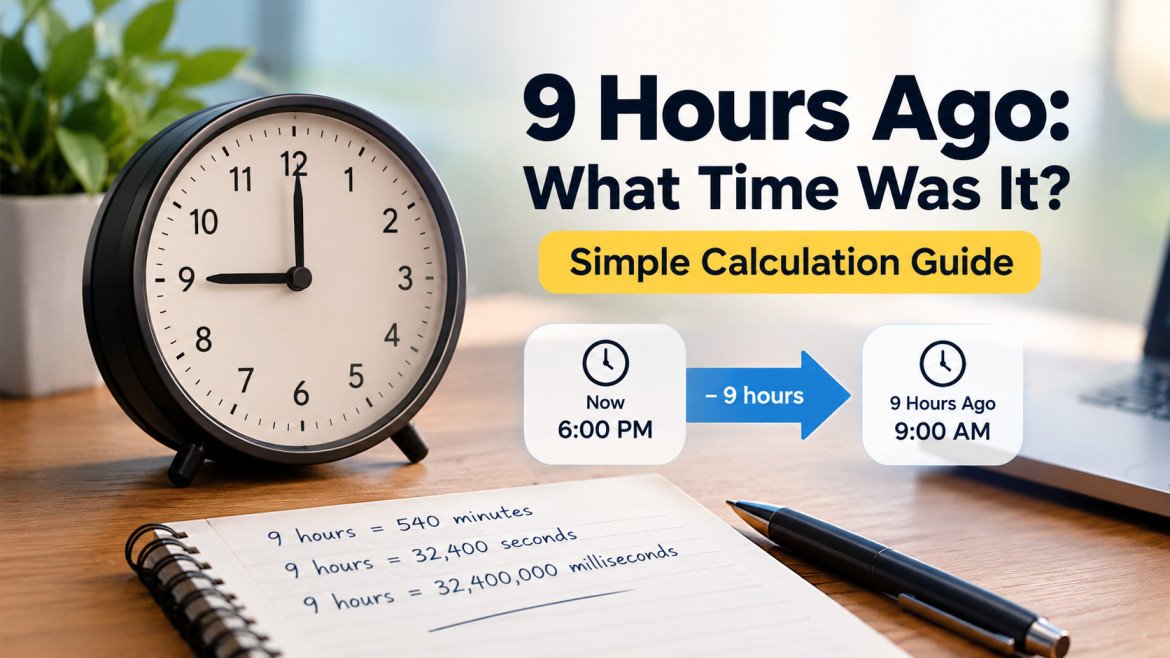
To calculate 9 hours ago, subtract nine hours from the current or specified time. For example, if it is 6:00 PM now, nine hours ago was 9:00 AM. If it is 4:00 AM, the answer is 7:00 PM on the previous day.
This guide explains how to calculate nine hours ago, handle midnight crossings, convert hours into minutes and seconds, and avoid common time calculation mistakes.
What Time Was It 9 Hours Ago?
The exact answer depends on your starting time. Nine hours ago is not a fixed clock time because the result changes throughout the day.
Here are some examples:
| Current Time | 9 Hours Ago |
|---|---|
| 12:00 PM | 3:00 AM |
| 2:00 PM | 5:00 AM |
| 6:00 PM | 9:00 AM |
| 9:00 PM | 12:00 PM |
| 11:00 PM | 2:00 PM |
| 4:00 AM | 7:00 PM yesterday |
| 7:00 AM | 10:00 PM yesterday |
These examples assume the same time zone and ordinary clock arithmetic. When the calculation crosses midnight, the result belongs to the previous calendar day.
How to Calculate 9 Hours Ago
The basic formula is straightforward:
Starting time − 9 hours = time nine hours ago
For example, if your starting time is 8:00 PM, subtracting nine hours gives you 11:00 AM on the same day.
If the starting time is 5:00 AM, subtracting nine hours takes you past midnight. The answer is 8:00 PM on the previous day.
You can calculate the result mentally by moving backward one hour at a time or subtracting the hours directly. A digital time calculator can also help when you need to work with multiple timestamps or exact dates.
What Happens When the Calculation Crosses Midnight?
Midnight marks the beginning of a new calendar day. If you subtract nine hours from an early morning time, your answer may fall on the previous day.
For example:
- Starting time: 3:00 AM on Tuesday
- Subtract nine hours.
- Result: 6:00 PM on Monday.
Remember to check both the clock time and the date. This is especially important when reviewing work records, online activity, messages, or scheduled events.
How Many Minutes and Seconds Are in 9 Hours?
Converting hours into smaller units is useful when calculating durations or working with digital systems.
Nine hours in minutes
One hour contains 60 minutes.
9 × 60 = 540 minutes.
Therefore, nine hours equals 540 minutes.
Nine hours in seconds
One hour contains 3,600 seconds.
9 × 3,600 = 32,400 seconds.
Therefore, nine hours equals 32,400 seconds.
Nine hours in milliseconds
One second contains 1,000 milliseconds.
32,400 × 1,000 = 32,400,000 milliseconds.
Therefore, nine hours equals 32,400,000 milliseconds.
These conversions are useful for timers, software applications, digital records, and other tasks involving precise time intervals.
Does AM or PM Affect the Calculation?
Yes. When using a 12-hour clock, you need to account for AM and PM when subtracting hours.
For example, subtracting nine hours from 6:00 PM gives 9:00 AM. However, subtracting nine hours from 3:00 AM gives 6:00 PM on the previous day.
The 12-hour clock uses AM for the period before noon and PM for the period after noon, with 12:00 AM representing midnight and 12:00 PM representing noon.
If you prefer the 24-hour clock, the same examples become:
- 18:00 minus nine hours = 09:00.
- 03:00 minus nine hours = 18:00 on the previous day.
Both formats produce the same result when interpreted correctly.
9 Hours Ago vs. 9 Hours From Now
These expressions describe opposite directions in time.
Nine hours ago means subtracting nine hours from a reference time. Nine hours from now means adding nine hours.
For example, if the starting time is 10:00 AM:
- Nine hours ago was 1:00 AM.
- Nine hours from now will be 7:00 PM.
The elapsed duration is the same, but one calculation looks backward while the other looks forward.
When Should You Use a Time Calculator?
Manual subtraction is usually sufficient for a simple question. However, an online time calculator may be helpful when working with exact dates, multiple timestamps, or different time zones.
You may find a calculator useful for:
- Checking when a message or event occurred.
- Calculating working hours and shift durations.
- Reviewing digital activity records.
- Managing schedules and appointments.
- Converting hours into minutes, seconds, or milliseconds.
If you’re exploring other online platforms and digital topics, you can also read our guide to BrumeBlog.com. Choose related resources based on what you need, and verify important timestamps against the original records.
Keep in mind that time-zone differences and daylight saving changes can affect displayed local times. When accuracy matters, use the full date, time, and applicable time zone.
Frequently Asked Questions
What time was it 9 hours ago from now?
Subtract nine hours from your current local time. For example, if it is 5:00 PM, nine hours ago was 8:00 AM. The exact answer depends on your current time.
How many minutes are in 9 hours?
Nine hours equals 540 minutes because each hour contains 60 minutes.
How many seconds are in 9 hours?
Nine hours equals 32,400 seconds because each hour contains 3,600 seconds.
Does 9 hours ago mean yesterday?
Not always. If subtracting nine hours crosses midnight, the answer falls on the previous day. Otherwise, it remains on the same calendar day.
How can I calculate 9 hours ago without a calculator?
Subtract nine hours from the starting time. If you cross midnight, move the date back by one day. Keep the minutes and seconds unchanged when subtracting exactly nine hours.
Final Thoughts
Calculating nine hours ago is simple once you know the starting time. Subtract nine hours, check whether the result crosses midnight, and confirm the correct AM or PM designation. For more precise calculations, include the date and time zone.
Whether you’re checking a timestamp, planning your schedule, or converting hours into smaller units, understanding this basic calculation can help you work with time more accurately.