

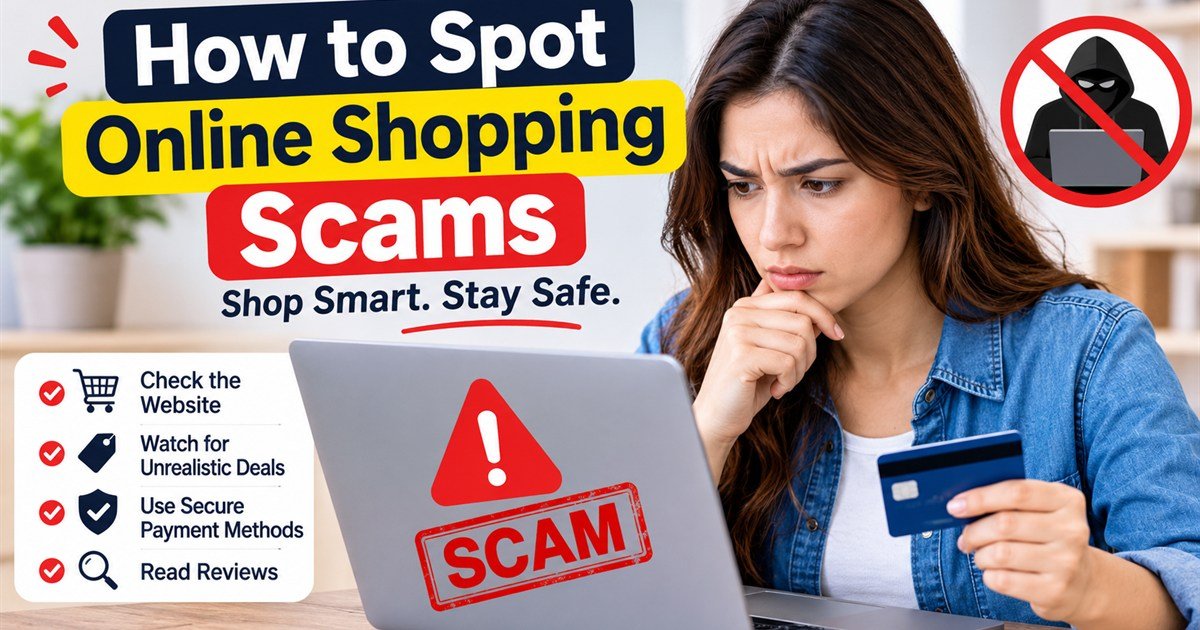
To spot online shopping scams, find the seller’s official website independently, check its contact and returns information, compare the price with other retailers, and use a payment method that offers a dispute process. A padlock or “https” address only encrypts the connection; it does not prove that a shop is genuine. Reporting routes differ by country, so use the official channel for where you live.
Check the seller before checkout
Search the store’s name and exact web address alongside terms such as “reviews,” “complaints” and “scam.” Do not rely only on reviews shown on the seller’s own site. Look for a real business name, usable contact details, clear delivery and returns terms, and a privacy policy. A new social media account, copied brand imagery, missing terms or pressure to buy immediately deserves extra scrutiny.
Compare the full price, including shipping, taxes and other fees. A large discount is not proof of fraud, but an unusually low price for a popular product is a reason to pause and verify the seller through the brand’s official website. Avoid opening checkout links sent unexpectedly by text, email or social media adverts.
Before paying, check which payment methods are accepted. Be wary if a seller insists on gift cards, cryptocurrency, wire transfers or a payment app with no clear purchase protection. A card payment is not a guarantee of reimbursement, but your card provider may have a dispute process if the goods never arrive or differ from what you ordered. Keep the order confirmation, product listing, receipts and messages.
Where to get help in the US, UK, Australia and UAE
United States
Contact your card issuer or payment provider quickly and ask how to dispute the transaction. Report suspected fraud to the Federal Trade Commission at ReportFraud.ftc.gov. The FTC’s online-shopping guidance recommends checking the seller and keeping purchase records.
United Kingdom
Follow the NCSC reporting guidance for suspicious stores and messages. Forward suspicious emails to report@phishing.gov.uk and scam texts to 7726. If you lost money in England or Wales, report it to Report Fraud; in Scotland, contact Police Scotland.
Australia
Scamwatch recommends confirming that you are using the retailer’s real website and checking for missing policies or suspiciously low prices. If you paid a suspected scammer, contact your bank promptly and report it to Scamwatch. If you shared personal information, Scamwatch lists IDCARE as a support option.
United Arab Emirates
Check that the seller provides clear information about its licensing entity, products or services, payment, terms and warranty. The UAE government lists consumer-complaint channels through the Ministry of Economy and emirate-level departments, including Dubai’s Department of Economy and Tourism. Check which channel handles your emirate. The UAE consumer-protection guidance notes that the law’s scope differs for e-commerce businesses registered outside the UAE, so cross-border purchases may need a different route.
If you already paid
Contact your bank, card issuer or payment provider using the number or app you normally use. Ask whether the payment can be stopped or disputed, and follow its time limits. Change any password you reused on the store, turn on multi-factor authentication where available, and watch for follow-up messages pretending to be the courier, bank or retailer. Save screenshots, receipts, the store address and all messages. Report the incident through the official channel for your country.
No checklist can prove that a seller is safe. If important details do not add up, pause the purchase and contact the brand or payment provider through a website or number you found independently.
Frequently Asked Questions
Does HTTPS mean an online shop is legitimate?
No. HTTPS encrypts information sent between your browser and the site, but scammers can use it too. Verify the seller separately.
What should I do if I paid a fake online store?
Contact your bank or payment provider promptly, preserve your order records and report the suspected scam through your country’s official reporting service.
Can I get my money back after an online-shopping scam?
It depends on the payment method, provider rules and local law. Ask your bank or provider about its dispute process as soon as possible; a refund is not guaranteed.
Are social-media shop ads always genuine?
No. Scammers can use fake ads or accounts that imitate real brands. Find the retailer’s official website independently and check the exact web address before buying.
Is a very low price proof that a shop is a scam?
No, but a price far below other retailers is a reason to pause and verify the seller. Compare the full price and check independent information before paying.
Can I trust reviews shown on the store’s own website?
Treat them as only one clue. Look for detailed, independent reviews elsewhere too, and be cautious if reviews are all very positive, vague or newly posted.
Is bank transfer a safe way to pay an unfamiliar online shop?
Pause if a seller insists on a transfer or another method with no clear purchase-dispute process. Check the payment provider’s terms before sending money.
What should I do if I entered my card details but did not complete checkout?
Contact your card issuer using its official app or number and ask what protection is appropriate. Monitor the account for unfamiliar transactions.
What if I used my usual password on a fake shop?
Change it anywhere else you used it, starting with email and financial accounts. Use a unique password for each account and turn on multi-factor authentication where available.
Should I click a delivery or payment link sent by the seller?
Avoid unexpected links. Open the retailer or courier’s official site or app yourself to check an order, and contact your bank through its official channel if you entered payment details on a suspicious page.