

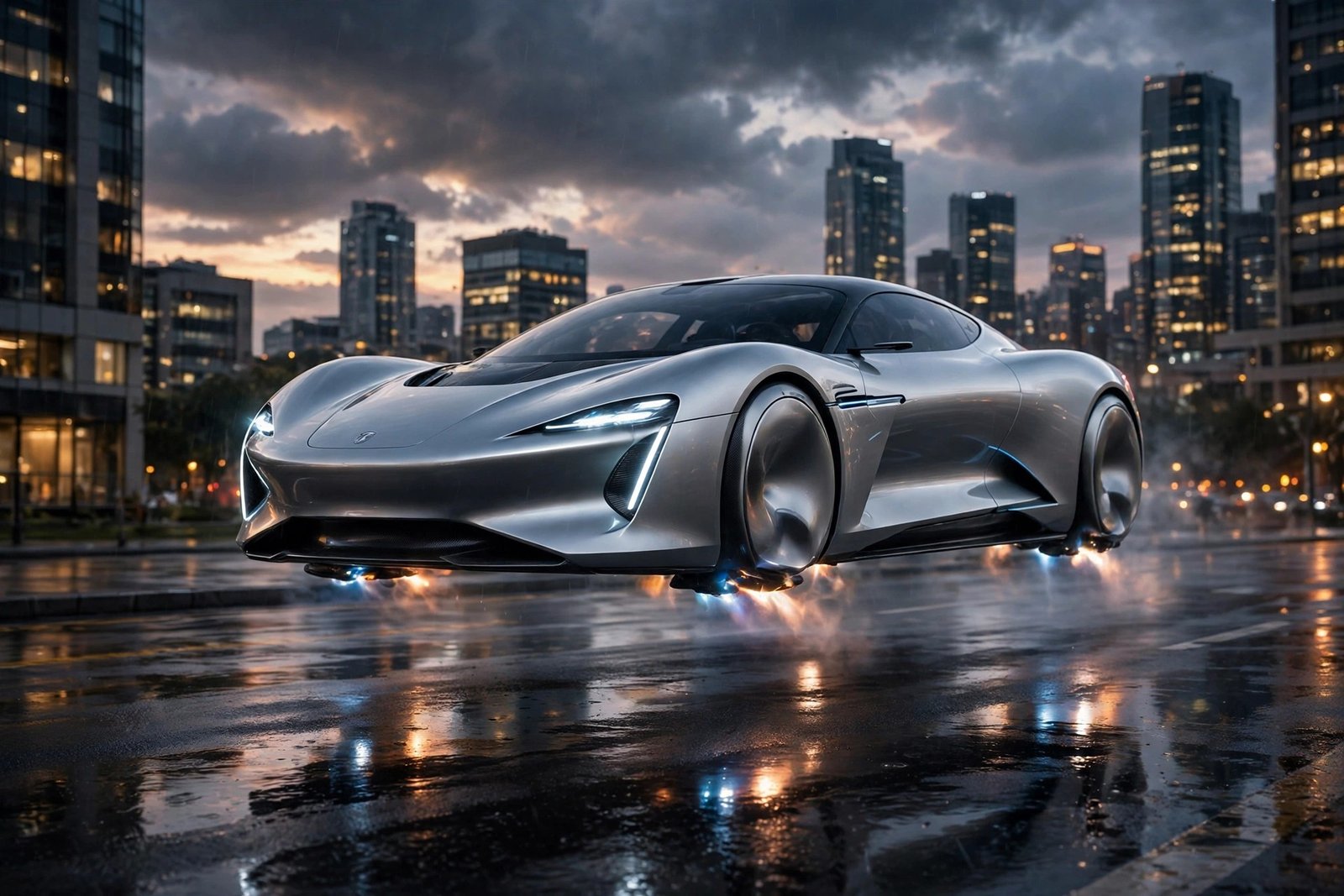
On 15 October 2026, a Tesla Roadster drove up a curved ramp in Texas, hung upside down, flipped in mid air and landed back on its wheels. The clip travelled around the world in hours, and for a day it looked like Tesla had invented the flying car.
Here is the part the clip does not show. While Tesla was rehearsing a stunt, China was already selling tickets. In Guangzhou and Shenzhen, passengers were boarding a pilotless electric aircraft, flying across the city for a few minutes, and landing on the other side, all under a full set of civil aviation certificates. No ramp, no stunt, no driver, and no one calling it a prototype.
So who actually wins the sky in 2027? The honest answer depends on what you mean by flying. Tesla built the most spectacular few seconds in car history. China built the most boring few minutes, and boring is what makes an air taxi real. This guide separates what each side actually did from what each side says it will do.
Short answer
If you want the car that flew, even briefly, it is Tesla’s Roadster. On 15 October 2026 at SpaceX’s test site in McGregor, Texas, an unmanned prototype used a fan suction system and cold gas thrusters to drive upside down on a ramp, flip in the air, and hop over a row of Teslas. It was seconds in the air, not a journey, and Tesla has not confirmed a final price or a road or air approval. Production is targeted at 2028.
If you want the aircraft that actually carries people today, it is China’s EHang EH216-S. It holds the world’s first full certification stack for a pilotless passenger aircraft, and it already flies paying passengers on short sightseeing and city routes in China, with a ticket on one cross border route costing about 800 yuan, roughly 110 dollars.
XPeng’s flying car arm, now called Aridge, sits in the middle. Its Land Aircraft Carrier pairs a six wheel electric carrier vehicle with a detachable two seat flying module, priced under 2 million yuan, about 280,000 dollars. The first unit rolled off its Guangzhou factory line in November 2025, it holds about 7,000 preorders, and deliveries are targeted for late 2026, but it still needs its aviation certificates before it can charge passengers for flights.
What Tesla actually showed in Texas
The event was short, under 30 minutes, and streamed live from SpaceX’s rocket test facility in McGregor, near Waco. Elon Musk was joined on stage by designer Franz von Holzhausen and vehicle engineering chief Lars Moravy. The car on show was a redesigned second generation Roadster, nine years after the first prototype appeared in 2017.
The demo ran in three parts. First, the car drove up a specially built curved ramp and travelled upside down along it, held to the surface by a fan based suction system that Tesla says can generate up to 2G of downforce. Then it launched off the ramp, rotated in the air and landed on its wheels, helped by cold gas thrusters. Then it used the thrusters again to leap over a parked lineup of a Cybercab, Cybertruck, Semi, Model Y and Model 3 while already moving.
Nobody was inside the car. Musk said that was to make sure nobody got killed, and every report of the night agrees the demos were unmanned. The setting was controlled too, with a purpose built ramp, a test site and a safety perimeter, and reports say the aviation authority set flight restrictions around the site before the event.
The hardware is real engineering, and it is worth understanding properly. The thrusters are cold gas thrusters, supplied by SpaceX. They do not burn fuel. They release stored, very high pressure air through nozzles to push the car, with no combustion anywhere in the system. Tesla says the car carries about 600 litres of compressed air, roughly 250 kilograms, in carbon fibre wrapped pressure tanks, feeding 10 nozzles around the car. Moravy said the rear thrusters push gas out faster than the speed of sound and generate more than 80 kilonewtons of thrust. The tanks recharge from an onboard pump, so the car needs no special fuel.
Tesla also announced three versions. Performance is described as road ready with two seats. Thrust adds rear thrusters and is described as race ready, also with two seats. Rocket is described as air ready with a single seat, and Tesla’s own post about it said, in effect, yes, it can fly. The Rocket version carries six more thrusters plus a 400 litre tank in place of the passenger seat.
On performance, Tesla timed 0 to 60 mph at 0.81 seconds on stage, and quotes a top speed above 230 mph and more than 300 miles of range. Treat those as company claims for now, because no independent test has verified them yet.
What Tesla has not shown yet
This is where the honest framing matters. The Roadster did short hops, measured in seconds, inside a closed test site. That is not sustained flight, it is not a flight from one place to another, and it is not something a buyer can do on a public road or in public airspace.
Tesla has not confirmed a final selling price. Press reports put the reservation deposits at 50,000 dollars for the Performance version and 250,000 dollars for the Thrust version, but a deposit is not a price, and Tesla itself has not published one. The 2028 production target comes from Musk, not from a confirmed delivery schedule, and the first Roadster was already delayed for years before this reveal. Reports also say the flying features are not approved for public roads, and no aviation authority has approved the car as an aircraft.
None of that makes the demo fake. The car really did what the video shows. It makes the demo a beginning, not a product. A buyer in 2027 cannot order a flying Roadster, cannot drive it to an airport, and cannot fly it to work. What a buyer can do is reserve a place in line for a car Tesla aims to start building in 2028.
What China actually flies today: the EHang EH216-S
China’s answer to the flying car is less dramatic and much further along. The EHang EH216-S is a two seat, fully autonomous electric aircraft with 16 rotors on eight arms. Passengers climb in, it follows a preset route on its own, and a ground monitoring centre watches the flight. There is no pilot on board at all.
What sets it apart is paperwork. China’s Civil Aviation Administration awarded it a type certificate in 2023, a production certificate in 2024, and a standard airworthiness certificate, making it the first pilotless passenger aircraft in the world to clear all three. In March 2025, the first air operator certificates followed, the first ever granted for civilian human carrying pilotless aircraft. No other eVTOL in the world holds that full stack.
Commercial flights are already running. In the first half of 2026, the EH216-S completed more than 1,500 commercial passenger flights and carried more than 3,000 passenger trips, with no safety accidents reported. Regular sightseeing and city flights run in Guangzhou, Shenzhen, Hefei and Chengdu, bookable by reservation. In January 2026, a cross border service between Shenzhen and Hong Kong started, at about 800 yuan per passenger, roughly 110 dollars. In December 2025, an EH216-S crossed the 22 kilometre Qiongzhou Strait between Hainan Island and the Guangdong mainland in 18 minutes, proving the aircraft can handle open water, salty air and real wind.
The honest limits matter too. The EH216-S cruises at about 100 km/h, with a top speed of 130 km/h, a range of about 35 kilometres, and a flight time of roughly 21 minutes. That is a short hop, not a regional journey. And the operator certificates granted so far cover sightseeing and experience flights that take off and land at the same site, not scheduled point to point passenger transport. EHang is also working on a longer range aircraft, the VT-35, for intercity routes, but that is a future product, not a flying one today.
Even with those limits, the difference from Tesla is stark. The EH216-S is a certified aircraft flying real passengers on real routes, today. The Roadster is a car that flew for seconds in a test site. One is a transport service, the other is a demonstration.
XPeng’s flying car: a van that carries its own aircraft
XPeng took a different route from both Tesla and EHang. Its flying car arm, XPeng AeroHT, rebranded as Aridge in October 2025, decided not to make one vehicle that both drives and flies. Instead it built two: a six wheel electric carrier vehicle, and a detachable two seat flying module that docks in its rear.
The idea is simple. The carrier drives like a luxury electric vehicle, with more than 1,000 kilometres of CLTC range from its extended range powertrain, and it carries the flying module to wherever you want to take off from. The air module then unfolds and flies short hops of 35 to 40 kilometres per charge, good for five or six flights, before docking again to recharge.
The price is set at under 2 million yuan, about 280,000 dollars, for the complete system. That is expensive for a car, and cheap for an aircraft, which tells you who the first buyers are: companies and wealthy individuals, not commuters. Preorders opened in late 2024 and reached about 7,000 refundable deposits by January 2026, including about 600 from a single Middle East signing covering the UAE, Qatar and Kuwait.
The factory is real. Aridge’s Guangzhou plant, about 120,000 square metres, completed construction in September 2025, and the first Land Aircraft Carrier flying module rolled off the line on 3 November 2025. Initial capacity is 5,000 units a year, scaling to 10,000. Deliveries are targeted for late 2026 in China, with the Middle East following in 2027.
But the certification gap is real too. Aridge still needs a type certificate, an airworthiness certificate and an air operator certificate before it can charge passengers for flights. A completed factory is not a certified production line, and preorders are not revenue. The Land Aircraft Carrier is further along than the Roadster, because it is a factory built product with a delivery target, but it is not yet a certified aircraft carrying passengers like the EH216-S.
Why China is ahead: the low altitude economy
None of this happened by accident. China has made low altitude flying a national policy, under the name of the low altitude economy. In December 2025, China’s national legislature passed a revised Civil Aviation Law that, for the first time, wrote unmanned aircraft and low altitude operations into national primary legislation. It took effect on 1 July 2026.
The policy support shows up in hardware too. GAC’s GOVY AirCab, a compound wing eVTOL with a pilot seat for its first certification, has collected more than 2,000 letters of intent and was targeting completed airworthiness certification and first deliveries by the end of 2026. One industry analysis puts the low altitude economy market at 14 billion dollars by 2030, with China aiming to take the largest share.
The United States has no equivalent framework yet. Tesla’s demo needed temporary flight restrictions around a test site, and the American eVTOL makers, Joby and Archer, are still working through FAA certification with timelines stretching toward 2027. China certified first, and it is scaling first.
The three machines side by side
| Machine | What it is | Flight | Passengers | Price | Certification | Status in late 2026 |
|---|---|---|---|---|---|---|
| Tesla Roadster Rocket | Road car with cold gas thrusters | Seconds long hops in a test site | 1, driverless demo only | Not confirmed, deposits reported at 50,000 and 250,000 dollars for other trims | None, not approved for roads or air | Prototype demo, production targeted 2028 |
| EHang EH216-S | Pilotless two seat eVTOL air taxi | About 35 km, 21 minutes | 2, no pilot | About 800 yuan, 110 dollars, per passenger on one route | Full CAAC stack, type, production, airworthiness and operator certificates | Certified, flying paying passengers |
| XPeng Aridge Land Aircraft Carrier | Six wheel carrier plus detachable two seat eVTOL | 35 to 40 km per charge, 5 to 6 flights | 2 in the air module, 4 in the carrier | Under 2 million yuan, about 280,000 dollars | Not yet certified | Factory built, 7,000 preorders, deliveries targeted late 2026 |
Read the table from right to left and the story is clear. The further right a machine sits, the closer it is to something you can actually use. Tesla leads on spectacle and raw performance claims. EHang leads on the only column that decides whether a flying vehicle is real: certification and paying passengers.
Who wins the sky in 2027
Tesla wins the show. No other car maker has made a road car flip in mid air, and the engineering behind it, a fan suction system plus SpaceX cold gas thrusters, is genuinely new. If the Rocket version ever reaches buyers, it will be the only car you can buy that is also, in some sense, an aircraft. But a show is not a service, and 2027 buyers should not plan their transport around it.
EHang wins the sky itself. It is the only machine here that a member of the public can book, board and fly in today, under a complete set of aviation certificates. Its flights are short, its routes are sightseeing rather than commuting, and its 35 kilometre range will not replace a taxi. But every other flying vehicle in this article is measured against a standard EHang already met: certified, commercial, and carrying passengers without an accident record.
Aridge wins the most interesting middle ground. A modular flying car solves the problem every other design ignores, which is where you keep an aircraft when it is not flying. A van that carries its own eVTOL is a practical idea, and its factory and preorder book are serious. If it clears certification in 2027, it becomes the first flying car a private buyer can actually own and use, rather than just watch.
China wins the race as a country. It certified first, it flies passengers first, it built the factories first, and it wrote the law first. The United States still has the most spectacular car, but China has the most working sky.
What to watch in 2027
Four dates and decisions will settle this contest. First, whether Aridge receives its type certificate and starts deliveries in China on schedule, or slips into 2027. Second, whether EHang expands beyond sightseeing flights into scheduled point to point routes, which is the step that turns an attraction into transport. Third, whether Tesla publishes a real price and a firm delivery date for the Roadster, or whether 2028 slips the way every earlier Roadster date did. Fourth, whether American regulators create a certification path for pilotless passenger aircraft anything like as fast as China’s, because without one, the most advanced American flying cars will keep flying only in test sites.
For buyers, the practical advice is simple. In 2027, you can buy a ticket on a Chinese air taxi, you can preorder a Chinese flying car, and you can reserve a Tesla Roadster. Only the first of those three is a journey. The other two are promises, and promises in this industry have a habit of arriving late.
The bottom line
Tesla made a car fly for a few seconds, and the world watched. China made aircraft fly paying passengers for a few minutes, and the world mostly did not notice. The seconds were more spectacular. The minutes are more important.
If you want to see the future of the sky, watch the Roadster video. If you want to ride in it, book a flight in Guangzhou. In 2027, the sky belongs to whoever certifies first, and right now, that is China. Tesla’s job is to turn a stunt into a product. China’s job is to turn a sightseeing flight into a commute. Whoever does their job first wins the sky.
For the road going version of this contest, see our comparison of Tesla vs BYD, XPeng, NIO and Xiaomi in 2027, where the same brands fight over price, range and charging instead of altitude. And for the cars that already command the biggest money on earth, our guide to the most expensive cars ever sold at auction shows what collectors pay when a car can fly only in their imagination.
FAQs
Can the Tesla Roadster really fly?
Briefly, yes, and only in a test site. On 15 October 2026, an unmanned Roadster prototype used a fan suction system and cold gas thrusters to drive upside down on a ramp, flip in mid air and hop over other Teslas at SpaceX’s McGregor site in Texas. It was seconds in the air, not sustained flight, and it is not approved for public roads or public airspace.
How does the Tesla Roadster fly?
It uses two systems. A fan based suction system under the car generates downforce, which Tesla says reaches up to 2G, and that held the car to the inverted ramp. SpaceX derived cold gas thrusters then push it through the air. The thrusters release stored, very high pressure air through 10 nozzles, with no combustion. Tesla says the car carries about 600 litres of compressed air in carbon fibre wrapped tanks.
How much does the Tesla flying Roadster cost?
Tesla has not confirmed a final selling price. Press reports put the reservation deposits at 50,000 dollars for the Performance version and 250,000 dollars for the Thrust version, but a deposit is not a price. Treat any price you see quoted for the Roadster as reported, not confirmed, until Tesla publishes one.
When will the Tesla Roadster be available?
Tesla, through Elon Musk, targets production starting in 2028. That is a target, not a confirmed delivery date, and the Roadster has already been delayed for years since the first prototype appeared in 2017. No deliveries have been confirmed.
What is China’s EHang EH216-S?
The EH216-S is a two seat, fully autonomous electric air taxi built by EHang in Guangzhou. It has 16 rotors on eight arms, no pilot on board, and it flies preset routes while a ground centre monitors the flight. It cruises at about 100 km/h, with a range of about 35 kilometres and a flight time of roughly 21 minutes.
Is the EHang EH216-S certified to carry passengers?
Yes. It holds a type certificate, a production certificate and a standard airworthiness certificate from China’s Civil Aviation Administration, plus air operator certificates granted in March 2025. It is the first pilotless passenger aircraft in the world to hold that full set of approvals, and it already flies paying passengers on sightseeing and city routes in China.
How much does an EHang air taxi ride cost?
On the Shenzhen to Hong Kong cross border service launched in January 2026, a ticket costs about 800 yuan per passenger, roughly 110 dollars. Prices on sightseeing routes in Guangzhou, Shenzhen, Hefei and Chengdu vary by route, so check the operator’s booking page before you travel.
What is the XPeng Land Aircraft Carrier?
It is a modular flying car system from XPeng’s flying car arm, now called Aridge. A six wheel electric carrier vehicle, with more than 1,000 kilometres of CLTC driving range, carries a detachable two seat flying module in its rear. The air module flies short hops of 35 to 40 kilometres per charge, then docks again to recharge.
How much is the XPeng flying car and when can you buy it?
The complete system is priced under 2 million yuan, about 280,000 dollars. The first unit rolled off the Guangzhou factory line on 3 November 2025, and Aridge holds about 7,000 preorders, with deliveries targeted for late 2026 in China. It still needs its aviation certificates before it can charge passengers for flights, so no delivery date is guaranteed.
Who is winning the flying car race in 2027?
China, on results. EHang’s EH216-S is certified and already carries paying passengers, Aridge has a factory and 7,000 preorders, and China wrote low altitude flying into national law in 2026. Tesla has the most spectacular demonstration, but its Roadster is still a prototype with no confirmed price, no certification and a 2028 production target.
Will flying cars replace normal cars?
Not in 2027, and not for most people for years after that. The aircraft flying today carry two passengers for about 20 minutes over short distances, and the ones you can buy cost around 280,000 dollars. Flying cars will first serve tourism, short city hops and wealthy early adopters. For everyday travel, a normal electric car remains cheaper, more practical and far easier to park.
[…] The contest is also moving off the road: see Tesla’s Flying Roadster vs China’s Electric Flying Cars in 2027. […]