

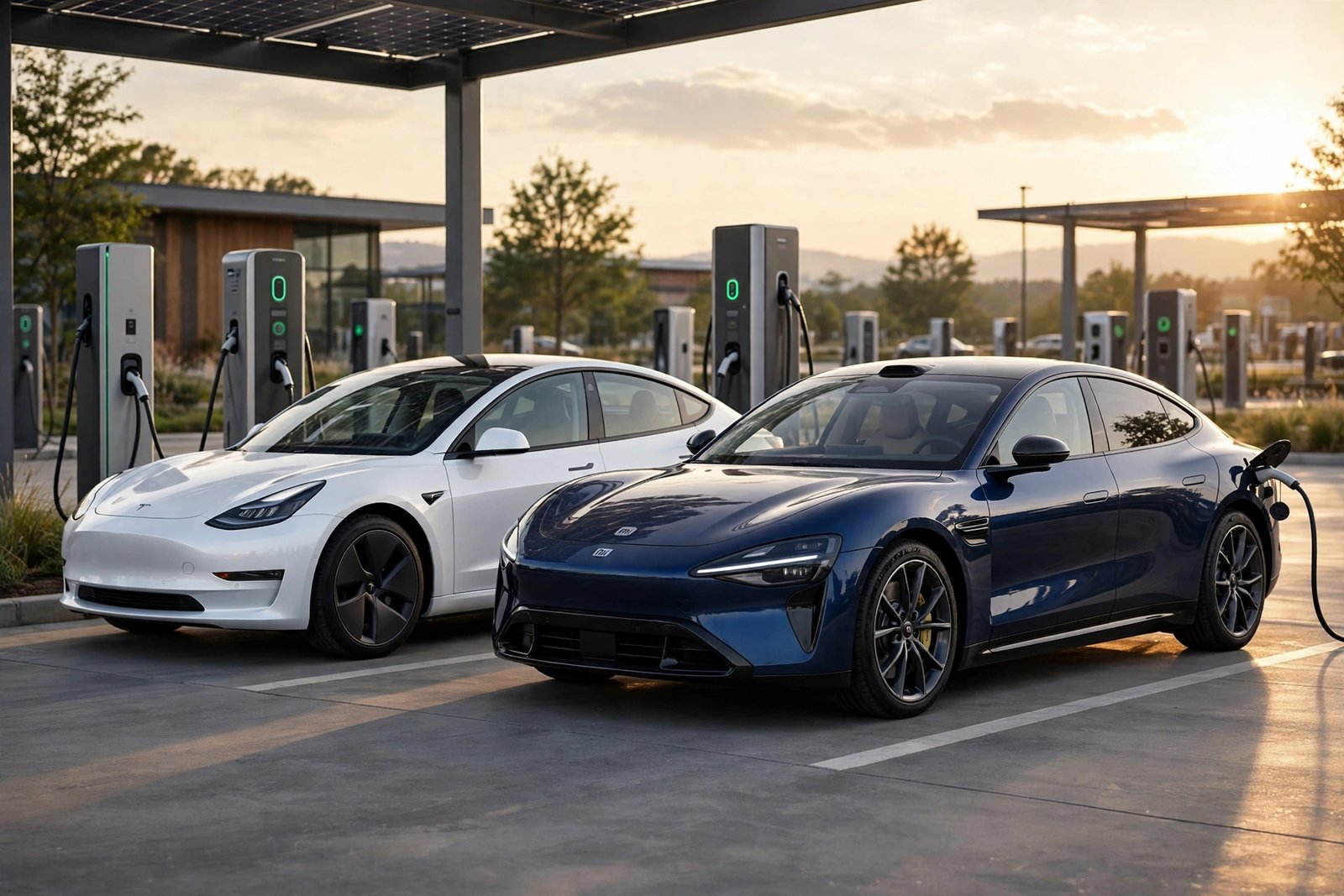
Tesla used to be the whole electric car story. That is no longer true. In 2027, the most interesting comparison in electric cars is Tesla against the Chinese brands that now set the pace on price, cabin tech and charging speed. BYD, XPeng, NIO and Xiaomi all build cars that would have sounded impossible five years ago, and several of them cost less than a Tesla while offering more range on paper.
Paper is the key word. These cars are tested in different ways, sold in different markets, and in one important case not sold in the United States at all. This guide compares them fairly, with the test cycle named next to every range figure, so the numbers mean something.
Short answer
If you live in the United States, Tesla still wins on the simple question of what you can actually buy and charge easily. The Model 3 starts at $36,990 before fees, the Model Y at $39,990, and the Supercharger network remains the easiest way to road trip an electric car in America. No major Chinese brand sells new passenger cars in the US.
If you live in Europe, the UK, Australia or much of Asia, the choice is much closer. A BYD Seal costs roughly $35,000 in equivalent terms and offers a 355 mile WLTP range, while an XPeng G6 starts near $27,600 in China with 800 volt fast charging. Chinese cars usually give you more equipment for the money, and their cabins feel newer. Tesla still leads on charging network, software updates and resale confidence in most markets where both are sold.
The range warning you need first
Do not compare a Tesla EPA figure with a Chinese CLTC figure as if they were the same test. They are not.
EPA, used in the United States, is the strictest of the three common cycles and usually gives the lowest number. WLTP, used in Europe, sits in the middle. CLTC, used in China, is the most generous and usually gives the highest number. The same car can look 20 to 30 percent better on CLTC than it would on EPA. Every range figure in this article names its cycle, and the comparison table keeps the cycles separate for that reason.
The cars in this comparison
Tesla is represented by the two cars most buyers actually choose, the Model 3 sedan and the Model Y SUV. The Chinese side is represented by the five models international buyers ask about most: BYD Seal, BYD Atto 3, XPeng G6, NIO ET5 and Xiaomi SU7. Prices below are starting prices checked in November 2026. Tesla prices change without notice, and Chinese prices are China list prices unless stated otherwise, so check the configurator on the day you order.
Price and range at a glance
| Car | Starting price, checked Nov 2026 | Battery | Range, with test cycle | 0 to 60 mph |
|---|---|---|---|---|
| Tesla Model 3 RWD | $36,990, US, before $1,640 destination and order fees | About 60 kWh | 321 miles, EPA | 5.8 seconds |
| Tesla Model 3 Premium RWD | $42,490, US, before fees | Larger pack | 363 miles, EPA | Not published for this trim |
| Tesla Model Y RWD | $39,990, US, before fees | About 60 kWh | 321 miles, EPA | 6.8 seconds |
| Tesla Model Y Premium RWD | $45,990, US, before fees | Larger pack | 357 miles, EPA | 5.4 seconds |
| BYD Seal | About $35,000 equivalent, global markets | 82.5 kWh | 355 miles, WLTP | About 5.9 seconds, rear wheel drive |
| BYD Atto 3 | About $27,000 equivalent, global markets | 60.5 kWh | 260 miles, WLTP | 7.3 seconds, 0 to 100 km/h |
| XPeng G6 | About $27,600, China list price | 68.5 or 80.8 kWh | 470 to 525 km, WLTP in Europe, 625 to 725 km, CLTC in China | 6.3 seconds, 0 to 100 km/h |
| NIO ET5 | About $41,100, China list price | 75 or 100 kWh | 435 to 560 km, WLTP in Europe, 585 to 740 km, CLTC in China | 4.0 seconds, 0 to 100 km/h |
| Xiaomi SU7 | About $29,800, China list price | Up to 101 kWh, Max trim | Up to 902 km, CLTC in China | 5.3 seconds, 0 to 100 km/h, Standard trim |
Tesla prices are US list prices from Tesla’s own site, checked in November 2026. The federal $7,500 credit is gone for cars bought after 30 September 2025, so these are the prices buyers actually face. Chinese brand prices are indicative equivalents, not US prices, because these cars are not sold new in the US.
Tesla Model 3 and Model Y: the benchmark
The Model 3 is the cheapest Tesla, and in 2027 it is also one of the most efficient electric cars you can buy. The entry rear wheel drive car starts at $36,990 and is rated at 321 miles by the EPA. Spend $42,490 on the Premium rear wheel drive version and range rises to 363 miles, which is the longest range in the Tesla lineup at that price. The Performance trim costs $54,990, reaches 60 mph in 2.9 seconds, and trades some range for speed, at 316 miles EPA in the latest listing.
The Model Y is the family version of the same idea. It starts at $39,990 for the rear wheel drive car, with 321 miles of EPA range. The Premium rear wheel drive version costs $45,990 and reaches 357 miles. A new six seat Model Y L starts at $61,990 and is aimed at buyers who need a third row without moving to a much larger car.
What Tesla still does better than almost anyone is the ownership experience around the car. Superchargers are easy to find, easy to use and fast. Software updates arrive over the air and genuinely change the car, adding features and improving range estimates over time. The cabin is plain to the point of stark, with almost everything controlled through one screen, which some buyers love and others never get used to. Build quality has improved a lot from the early years, but panel gaps and paint still draw more complaints than buyers expect at this price.
BYD Seal and Atto 3: the value leaders
BYD is now the largest electric car maker in the world by volume, and the Seal is the car that shows why. It is a midsize sedan built on BYD’s e-Platform 3.0, with the company’s Blade Battery, which uses lithium iron phosphate chemistry. That chemistry is less energy dense than the nickel based packs in many rivals, but it is cheaper, more durable and less prone to thermal problems, which is part of how BYD keeps prices down.
The Seal costs about $35,000 in equivalent terms in its main markets, with an 82.5 kWh battery and a 355 mile WLTP range. The top all wheel drive version makes 523 horsepower and reaches 100 km/h in 3.8 seconds. Inside, the Seal feels more conventional than a Tesla, with a rotating centre screen, physical buttons for some functions, and a cabin that reviewers often describe as more premium than the price suggests.
The Atto 3 is the cheaper BYD, a compact SUV at about $27,000 equivalent, with a 60.5 kWh Blade Battery and a 260 mile WLTP range. It is slower and less polished than the Seal, at 7.3 seconds to 100 km/h, but it undercuts the cheapest Tesla by roughly $10,000 in markets where both are sold, and it comes well equipped as standard. For a family that wants a practical electric SUV and does not need Tesla’s charging network, the Atto 3 is the value pick in this whole comparison.
BYD’s weakness is charging speed. The Seal peaks at about 150 kW on a DC fast charger, and the Atto 3 at about 88 kW. Both are fine for daily use and overnight charging, but on a long road trip they spend longer plugged in than a Tesla or an XPeng.
XPeng G6: the charging surprise
The XPeng G6 is the car that embarrasses more expensive rivals on charging. It uses an 800 volt architecture, the same kind of system found in cars costing twice as much, and XPeng claims 10 to 80 percent charging in about 12 minutes under suitable conditions in Europe. Real world times vary with charger, temperature and battery state, but even at 20 minutes it is among the fastest charging electric SUVs at any price.
The G6 starts near $27,600 in China, with 625 to 725 km of CLTC range depending on battery, or 470 to 525 km on the stricter WLTP cycle in Europe. It is a coupe style SUV, roomy inside, and its driver assistance system, XNGP, is one of the most advanced available outside Tesla, with city driving assistance in China. The trade off is brand familiarity. XPeng is still building its dealer and service network in Europe and other export markets, and resale values are less proven than Tesla’s.
NIO ET5: the battery swap idea
NIO takes a different approach to the whole charging problem. Instead of waiting for a charge, ET5 owners in markets with swap stations can drive in, have the empty battery swapped for a full one in about three minutes, and drive out. It is the closest thing in electric cars to a petrol station stop. You can also buy the car with a smaller battery and rent a larger one when you need it, which lowers the purchase price.
The ET5 starts near $41,100 in China, with 75 or 100 kWh batteries and 435 to 560 km of WLTP range in Europe. It is quick, at 4.0 seconds to 100 km/h, and the interior is one of the nicest in this group, with soft materials and a calm design. The catch is the network. Battery swap stations are common in China but still rare in Europe, so outside China the ET5 is mostly a normal fast charging car, and you pay a premium price for a feature you may rarely use.
Xiaomi SU7: the phone maker’s car
Xiaomi, the phone company, built its first car in 2024 and it became an instant hit in China. The SU7 starts near $29,800 in China, offers up to 902 km of CLTC range in its longest range form, and connects deeply with Xiaomi phones, tablets and smart home devices. If your whole digital life runs through Xiaomi products, the car feels like another device in the same system, with the same account, the same voice assistant and the same apps.
The SU7 Max is the performance version, with an 897 volt platform and strong acceleration, while the SU7 Ultra is a 1,548 horsepower halo car that costs about $73,100 in China and reaches 100 km/h in under two seconds. For most buyers the standard SU7 is the relevant car, and it is remarkable value on paper. The honest limits are that Xiaomi is a new car maker, with a short service history and no sales network outside China yet, so long term reliability and parts availability are still unproven.
Charging and road trips
This is where Tesla still earns its price. The Supercharger network in the United States and much of Europe is large, reliable and simple to use, with plug in and walk away payment and live availability in the car’s navigation. Tesla’s route planner is also the best in the business at telling you honestly where to stop and for how long.
Chinese cars charge well in their home markets, where charging infrastructure is dense and often faster than in the West. XPeng’s 800 volt system is genuinely quick. NIO’s swap system is genuinely convenient where stations exist. BYD’s slower peak charging is the main weakness here, and it matters most on long trips, not in daily driving. If most of your driving is commuting with home charging, charging speed barely matters. If you drive long distances often, it matters a lot, and Tesla still has the edge.
Software, safety and cabin tech
Tesla’s software is still the benchmark for over the air updates, with new features arriving regularly and the whole car controlled through a clean, fast interface. Autopilot is standard, with Full Self Driving available as a paid option in some markets, though its capability and legal status vary by country and buyers should check local rules before paying for it.
Chinese brands have closed the gap fast, and in some areas passed Tesla. BYD, XPeng, NIO and Xiaomi all offer large screens, voice control, app based car control and advanced driver assistance as standard or cheap options. XPeng’s city driving assistance and NIO’s highway pilot are strong in their home market. Xiaomi’s phone integration is the most complete of any car in this price range. The difference is maturity. Tesla’s software has had a decade of real world testing and refinement. Chinese software is newer, sometimes more feature rich, and occasionally less polished in translation and menu logic outside China.
On safety, all five Chinese models discussed here carry five star Euro NCAP ratings or strong crash test results in their markets, and the Tesla Model 3 and Model Y also score highly. Buyers should check the exact rating for the exact trim and market, because equipment varies by country.
Which one should you buy in 2027
Buy the Tesla Model 3 if you want the lowest fuss electric car in the United States, the longest proven range per dollar, and the easiest road trips. Buy the Model Y if you need the extra space and seating height, and the Premium rear wheel drive version if range matters more than all wheel drive.
Buy the BYD Seal if you live where BYD is sold, want a premium feeling sedan for about the same money as a base Model 3, and mostly charge at home. Buy the BYD Atto 3 if budget is the priority and you want the cheapest practical electric SUV in this comparison.
Buy the XPeng G6 if fast charging and driver assistance tech matter to you, and you live near XPeng service and charging support. Buy the NIO ET5 if you live near battery swap stations and value the interior and the swap idea. Buy the Xiaomi SU7 if you are in China, already live in Xiaomi’s ecosystem, and want the most tech per dollar of any car here.
And if you live in the United States, the honest answer is that the Chinese cars are not an option yet, no matter how good the value looks on paper. Tariffs and trade rules keep them out of the US market, and none of the brands in this article runs a mainstream new car sales network there. That may change, but for 2027 buyers should plan on Tesla and the other brands actually sold in America.
The bottom line
Tesla is no longer the only smart choice, but it is still the safest choice in the United States. Outside the US, Chinese electric cars have earned a real place in the decision, mainly on price, equipment and charging tech, while Tesla keeps its lead on charging network, software maturity and resale confidence. The right car depends less on the badge now than on where you live, how you charge, and how often you drive long distances. Judge the range figures by their test cycle, check the price on the day you buy, and drive both before you decide.
For more on the luxury end of the car world, see our guide to the most expensive watches in the world in 2027, and for the classic car market that sits above all of these, our look at the most expensive cars ever sold. If you are buying any expensive car online, our guide on how to spot a fake online store before you pay covers the checks that protect a large purchase.
FAQs
Which is better, Tesla or BYD?
Neither wins outright. Tesla leads on charging network, software updates and resale confidence, especially in the United States. BYD leads on price and standard equipment in markets where both are sold. The Seal offers a 355 mile WLTP range for about $35,000 equivalent, while the Model 3 starts at $36,990 in the US with a 321 mile EPA range. Choose Tesla for road trips and ease of ownership, BYD for value and cabin comfort.
Are Chinese electric cars sold in the US?
No major Chinese brand sells new passenger cars in the US in 2027. BYD, XPeng, NIO and Xiaomi do not run mainstream US sales networks, and tariffs and trade rules keep their cars out. US buyers should compare Tesla with the electric cars actually sold in America, such as Hyundai, Kia, Ford and Rivian models.
Is the BYD Seal better than the Tesla Model 3?
On paper, the Seal gives you a bigger battery, a longer WLTP range and a more premium cabin for similar money. In daily use, the Model 3 charges faster on long trips, has better software and holds its value better in most markets. If you charge at home and rarely road trip, the Seal is the better value. If you drive long distances often, the Model 3 is the safer pick.
What is the cheapest Tesla in 2027?
The Tesla Model 3 rear wheel drive, at $36,990 before destination and order fees of $1,640, for a delivered price of $38,630. It is rated at 321 miles by the EPA. The cheapest Tesla SUV is the Model Y rear wheel drive, at $39,990 before fees, also rated at 321 miles.
What is the cheapest Chinese electric car in this comparison?
The XPeng G6, from about $27,600 in China, followed closely by the BYD Atto 3 at about $27,000 equivalent in global markets. Both are cheaper than the cheapest Tesla in markets where they are sold. Prices vary a lot by country because of taxes, import duties and equipment levels.
How do CLTC, WLTP and EPA range figures differ?
They are three different test cycles. EPA, used in the US, is the strictest and gives the lowest figure. WLTP, used in Europe, is in the middle. CLTC, used in China, is the most generous and gives the highest figure. The same car can look 20 to 30 percent better on CLTC than on EPA, so never rank cars by range without naming the cycle.
Does the XPeng G6 really charge in 12 minutes?
XPeng claims 10 to 80 percent in about 12 minutes under suitable conditions in Europe, thanks to its 800 volt system. Real world times vary with the charger, the battery temperature and the starting charge level. Even at 20 minutes, it is among the fastest charging electric SUVs at this price.
How does NIO battery swapping work?
At a NIO swap station, the car drives onto a platform, the empty battery is removed from underneath, and a full battery is fitted in about three minutes. Owners can also rent a larger battery for long trips. The system works well in China, where swap stations are common, but stations are still rare in Europe, so most European owners charge normally.
Is the Xiaomi SU7 reliable?
It is too early to say with confidence. The SU7 is Xiaomi’s first car, launched in 2024, and early reviews praise its performance, tech and value. Long term reliability, parts supply and service quality are still unproven, and the car is not sold outside China yet. Buyers in China should check warranty terms and local service coverage before ordering.
Should I buy a Tesla or wait for Chinese cars in 2027?
If you live in the US, do not wait for Chinese cars, because there is no confirmed date for their arrival and no sales network in place. If you live in Europe, the UK, Australia or Asia, Chinese cars are already on sale, so test drive both a Tesla and the Chinese rival you are considering. The right choice depends on your local charging, service and resale market, not on the global headlines.
Which Chinese electric car has the longest range?
In this comparison, the Xiaomi SU7 Max offers up to 902 km on the CLTC cycle in China. Among cars sold more widely, the BYD Seal offers up to 355 miles on WLTP, and the NIO ET5 offers up to 560 km on WLTP in Europe. Remember that CLTC figures are more generous than WLTP or EPA, so compare cars only on the same cycle.
[…] the other end of the car market, our comparison of Tesla vs Chinese electric cars in 2027 looks at what $30,000 to $45,000 buys in range, charging speed and cabin tech, from the Tesla Model […]